Structure alignment and classification
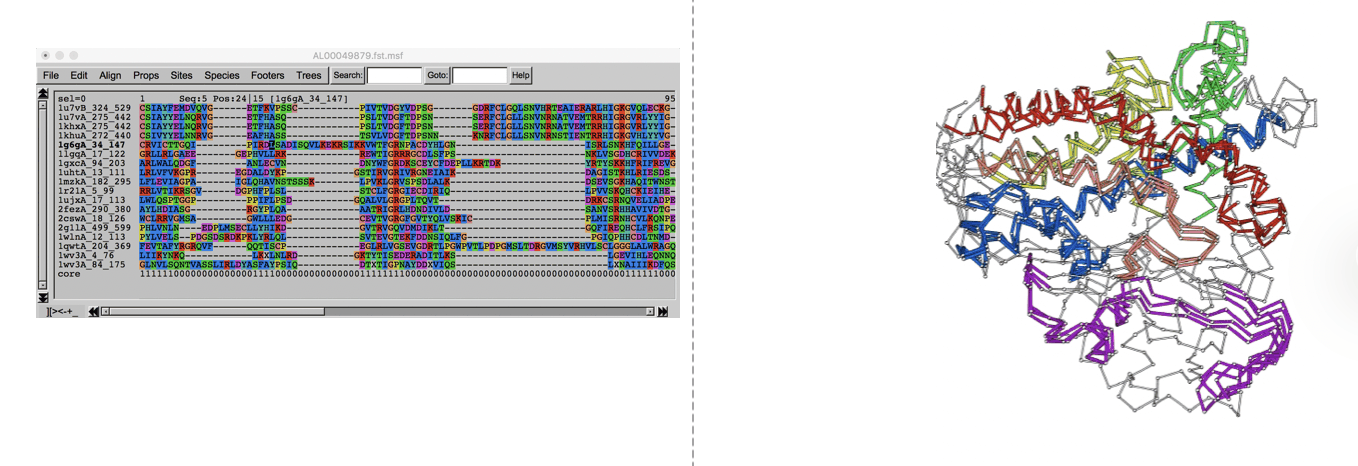
Multiple structure alignment recovers homologous positions better than sequence alignment does. Yet adding sequence information to structure makes alignments worse. The two signals are complementary — so how should they be combined?
This is where I started, and the question remains open. Structure is conserved far more than sequence — three to ten times more, by some estimates — while the number of known folds (around 1,400) is tiny next to the diversity of sequences. That gap is what makes structural information valuable for alignment and annotation, and what sent me looking for the best way to use it.
With Jacques Chomilier, I compared 23 multiple-alignment programs — sequence-only, structure-only, and hybrid — against 847 manually curated reference alignments from five databases. Structure-only methods came out on top, ahead of both sequence and hybrid programs; the two best, MAMMOTH and MATRAS, have almost nothing in common beyond the general strategy. The result held regardless of database, sequence identity or secondary structure — including, counter-intuitively, at high sequence identity, where I expected sequence alignment to catch up. Structure-based methods also tend to over-place gaps; sequence-based ones under-place them.
Earlier, during my PhD, I explored three approaches to multiple structure alignment: YAKUSA, a “structural BLAST” that scans a database for local similarity to a query structure by indexing backbone-angle sequences; Mafias and Gakusa, adaptations of established sequence-alignment algorithms; and, with Nadia Pisanti and Henry Soldano, Triades, a family of relational-motif methods that remains the only exact approach to multiple structure comparison. A new version of YAKUSA is in preparation with Sophie Brouillet.
Where this is going
Combining sequence and structure did not beat structure alone, which is disappointing: most families have far more sequences than solved structures, so a good hybrid method matters. The likely reason is that no explicit model of structural evolution exists to weigh the two signals against each other — which is what sends me back to structural evolution. With François Coste and Hugo Talibart, I am now testing a different route: aligning Potts models, the same co-evolution framework used for meta-omics annotation, pairwise first, and eventually for multiple alignment.
Papers
Protein multiple alignments: sequence-based versus structure-based programs Bioinformatics, 2019 DOI
A relational extension of the notion of motifs: application to the common 3D protein substructures searching problem Journal of Computational Biology, 2009 DOI
YAKUSA: a fast structural database scanning method Proteins: Structure, Function, and Bioinformatics, 2005 DOI
Also from this line of work: RPBS: a web resource for structural bioinformatics (Nucleic Acids Research, 2005), Incremental inference of relational motifs with a degenerate alphabet (CPM, 2005), and two book chapters. See Publications.