Annotating the unknown in meta-omics data
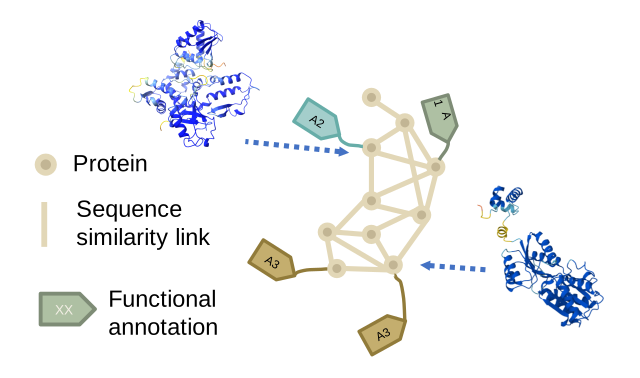
Most microbial lineages are unculturable, and much of what environmental sequencing returns is too divergent for annotation transfer to work. Can structural conservation recover the signal that sequence similarity loses?
Our picture of the diversity of life is inferred from a small number of culturable organisms. Large environmental datasets — Tara Oceans, the Earth Microbiome Project — offer access to the rest, but a large fraction of the sequences they return has no detectable homologue.
With Lucie Bittner, we use fold prediction and other structural features (disordered regions, secondary structure, transmembrane segments) to annotate these sequences, refining the functional assignment with the co-evolutionary information encoded in Potts models. The aim is then to build fold distribution profiles per community and relate them to environmental conditions. This work is part of the PEPR Atlasea programme and of Jeremy Rousseau’s PhD on dinoflagellates.
The approach has precedents on a smaller scale: in both papers below, structure prediction was what allowed a function to be assigned where sequence comparison alone was inconclusive.
Papers
Identification of a novel elastin-degrading enzyme from the fish pathogen Flavobacterium psychrophilum Applied and Environmental Microbiology, 2019 DOI
Genome sequence of the plant-pathogenic bacterium Dickeya dadantii 3937 Journal of Bacteriology, 2011 DOI