Structural evolution
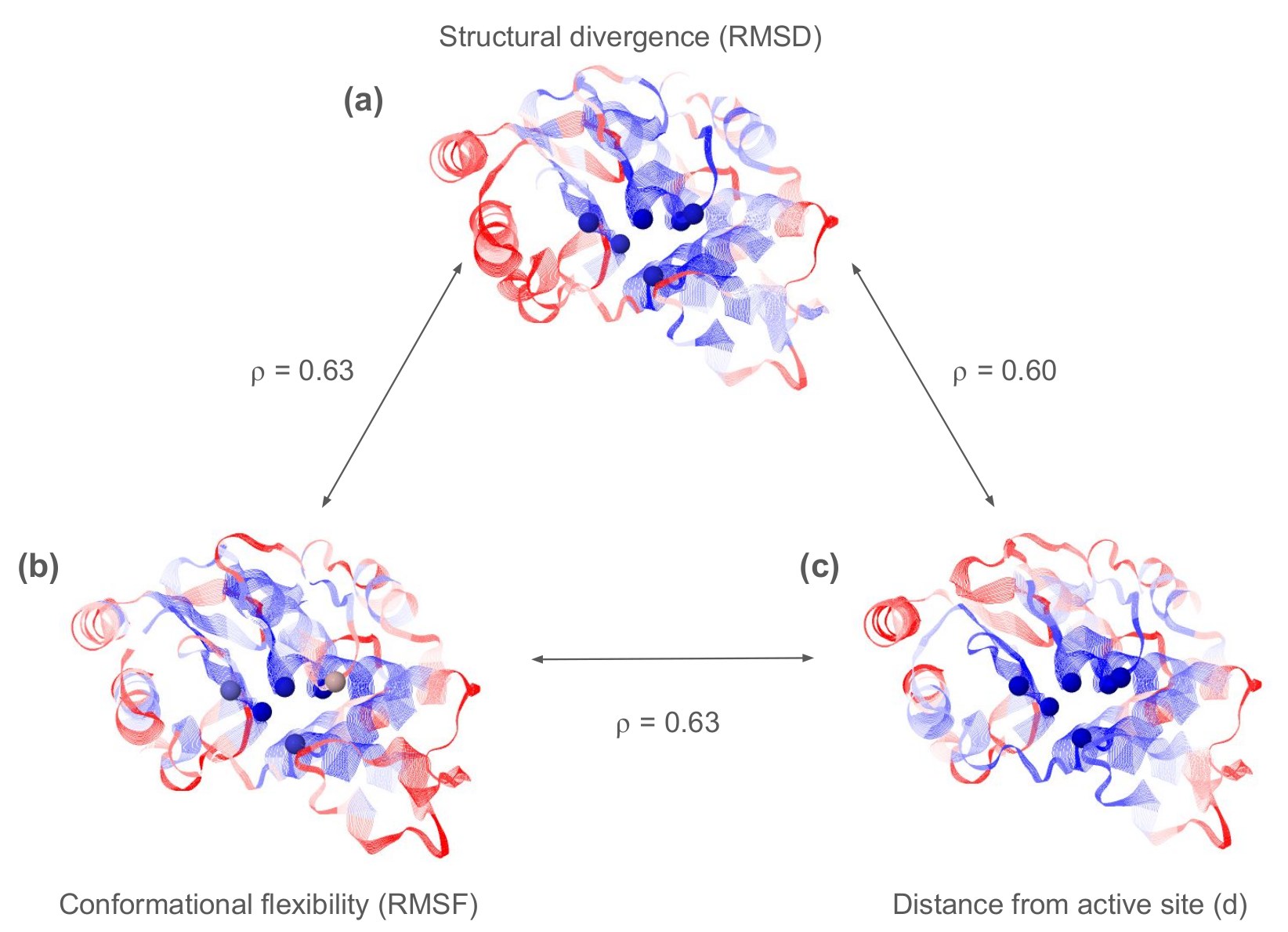 Figure from Echave & Carpentier, Proteins, 2026.
Protein structures diverge as sequences do — but not uniformly. What sets the rate at which each residue’s position drifts over evolution?
Working with Julián Echave, we first measured how structural divergence varies among residues across enzyme families — the residue-dependent structural divergence profiles — and then asked what evolutionary constraints shape them.
Applying a mutation–stability–activity model to 34 enzyme families, we found that mutation, stability and activity each contribute. But the balance among them varies widely from one family to another: mutation always weighs substantially, whereas the stability and activity contributions range from negligible to dominant, so any of the three can prevail. Structural divergence profiles therefore encode not only a protein’s architecture but the selective regime under which it evolved — the model recovers family-specific selection strengths from the profiles themselves.
This matters beyond description. A quantitative model of how structure evolves is exactly what is missing to guide structure-based alignment and homology detection — the gap that motivates most of my other work.
Papers
Why structural divergence varies among residues in enzyme evolution: contributions of mutation, stability, and activity constraints Molecular Biology and Evolution, 2026 DOI Preprint