Protein folds as phylogenetic characters
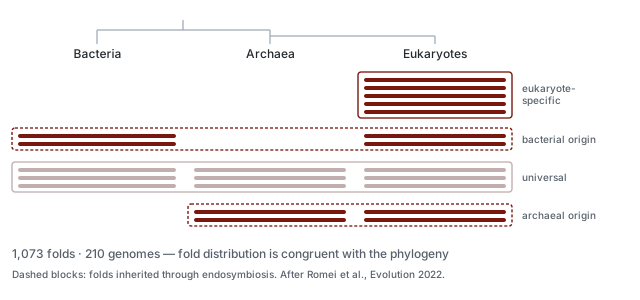
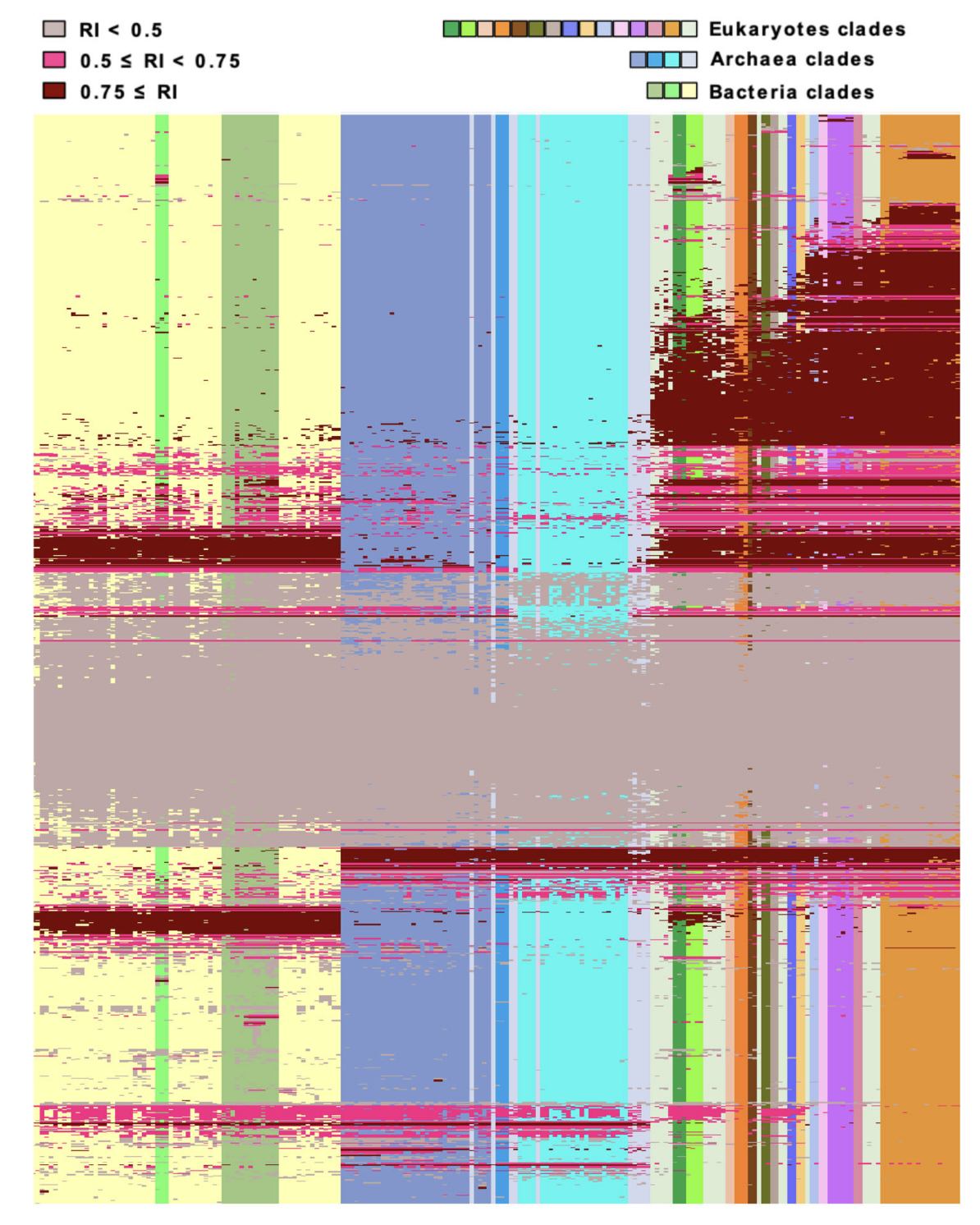 Figure from Romei et al., Evolution, 2022.
Only about 1,200 protein folds are known — orders of magnitude fewer than the number of sequences in the biosphere. Is that because folds are conserved characters, or because evolution keeps converging on the same few shapes?
The distinction matters: if convergence were frequent, folds would be useless for phylogeny. Martin Romei’s PhD, co-supervised with Guillaume Lecointre and Jacques Chomilier, settled it empirically. Across 210 complete genomes sampling bacteria, archaea and eukaryotes, fold distribution turns out to be strongly congruent with the reference phylogeny. Convergence is rare; folds are reliable characters, for deep and recent divergences alike.
The distribution also records specific events. Folds acquired through primary and secondary endosymbiosis are directly legible in it, and eukaryote-specific folds — far more numerous than those specific to either prokaryotic domain — are enriched in regulatory and extracellular functions, consistent with the onset of multicellularity.
Where this is going
Because horizontal transfer is frequent in prokaryotes, I now focus on eukaryotes to understand how new folds arise. The hypothesis I am pursuing is that structural evolution is modular: introns and exons delimit modules reshuffled by alternative splicing and exon shuffling, recurrent substructures are well documented, and ancient introns appear to delimit 3D modules of 15 to 30 residues. Locating introns within structures should tell us whether recent folds are recombinations of older substructures.
Papers
Protein folds as synapomorphies of the tree of life Evolution, 2022 DOI
Origins and functional significance of eukaryotic protein folds Journal of Molecular Evolution, 2023 DOI